-
-
-
400-685-8537

source: 仁树医疗 2026-06-05 16:29:05 Secondary reading
“Mom, I can’t see the blackboard clearly again!”
Many parents’ hearts sink when they hear this.
Then an eye exam shows another increase of over 100 degrees!
The glasses were only prescribed a year ago—why have they become insufficient so quickly?
Many parents’ first reaction is to question the quality of the glasses, or regret not intervening earlier. But the real problem often lies in a seriously overlooked step—
Letting things slide after getting glasses, with no follow-up exam for six months or even a year.
1. Getting glasses is not the finish line—it’s the starting point
First, let’s understand a basic fact: The essence of myopia is an elongation of the axial length of the eye.
In a normal adult, the axial length is about 23–24 mm. In myopic patients, it is longer—each 1 mm increase in axial length corresponds to roughly 250–300 degrees of myopia.
What’s more, once the axial length increases, it cannot be reversed. No method can make it “shrink back.”
Therefore, the core goal of myopia control has never been “cure myopia,” but rather to slow down the rate of axial elongation as much as possible.
A child’s eyeballs continue to develop from birth to adulthood, and the school-age period (6–12 years old) is when the axial length grows the fastest. During this window, if progress isn’t monitored, the degree of myopia can easily increase by 50–100 degrees every six months.
Glasses are essentially a corrective tool, not a control tool (though recent defocus-incorporated lenses can slow myopia progression). No matter what type of glasses you wear, if you don’t have follow-up exams, the lens parameters become outdated. This leads to two situations:
Under-correction: The prescription is too low. The child can’t see clearly, the eyes have to strain to focus, which actually accelerates myopia.
Over-correction: The prescription is too high. The child is in a state of excessive accommodation for a long time, leading to eye strain and headaches.
In either case, the child is walking around with “wrong glasses” to see the world. How could their vision be good? Regular follow-ups are meant to keep up with the changes in axial length and adjust the intervention strategy in time.
2. What exactly is checked during a follow-up?
Many parents go for a follow-up and only ask one question: “How much did the prescription go up?”
That question is fine, but it’s not enough. A complete myopia follow‑up typically includes the following core examinations:
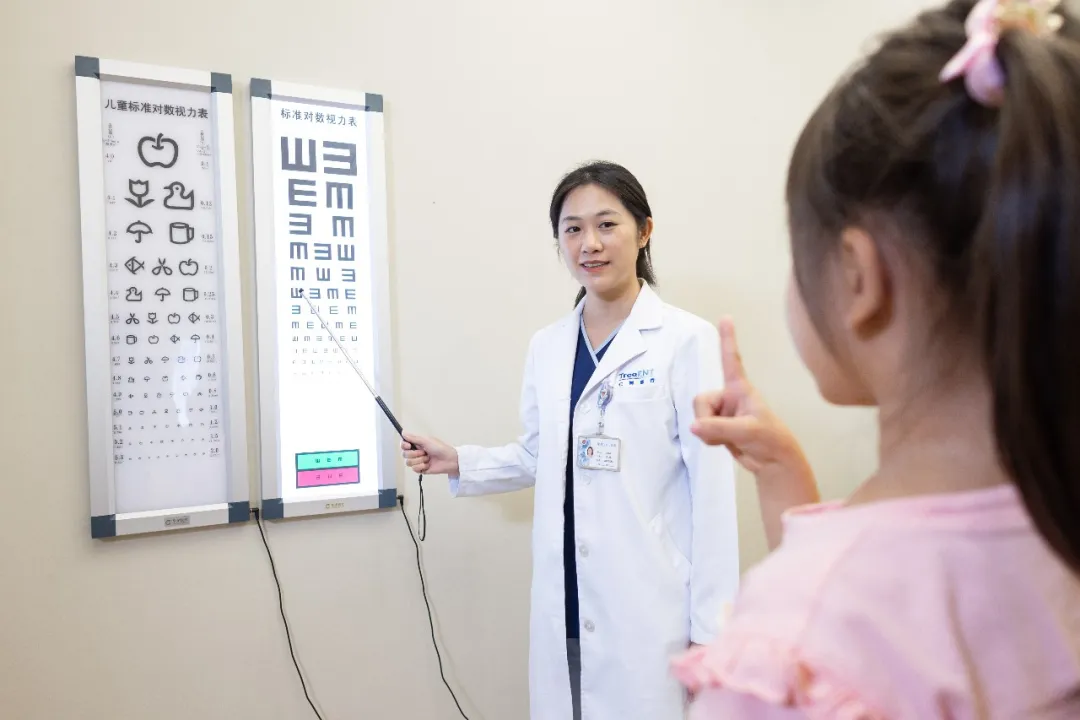
Uncorrected / corrected visual acuity: to understand the current visual status.
Cycloplegic refraction (dilated eye exam): to eliminate accommodative factors, obtain the true refraction, and also distinguish pseudomyopia.
Axial length measurement: the most objective and stable indicator of myopia progression.
Corneal curvature: to assess corneal shape and aid in lens selection.
Intraocular pressure: to rule out glaucoma risk.
Among these, axial length is the most critical indicator. Prescription can be affected by refraction conditions, accommodative effort, and other factors, occasionally leading to errors; but axial length is a physical value measured directly by instruments—objective and stable.
Not measuring axial length is like claiming “your blood pressure is normal” without measuring it—there’s no basis.
When you take your child for a follow‑up, take the initiative to ask the doctor two questions:
“How much has my child’s axial length increased since the last visit?”
“Does the current myopia control plan need to be adjusted?”
These two questions are far more informative than simply asking “How much did the prescription go up?”
Each follow‑up is not just a “checkup,” it’s an “evaluation”—an assessment of how well the current control strategy is working. Problems can be detected early and adjusted; the longer you wait, the higher the cost.
3. Waiting until they “can’t see clearly” is already too late
Many parents think: If my child doesn’t complain, there’s no problem.
But children often don’t say “I can’t see clearly” because they may not even know what “normal” looks like. When they get used to blur, they think blur is normal.
There is an even more hidden situation: When vision drops in only one eye, the child may have no sensation at all. Because the other eye compensates, and everything still looks clear. By the time parents notice it, the “quietly worsening” eye may have already increased significantly in degree, or even developed amblyopia (lazy eye).
By the time a child voluntarily says “I can’t see the blackboard clearly,” the prescription has often already increased by 50–100 degrees—the optimal intervention window has passed.
Q: How often should a follow-up be done normally?
Every 3–6 months is the basic rhythm of myopia control.
The frequency can be adjusted according to the situation:
School-age children (6–12 years): Recommended every 3 months. Axial length grows fastest at this stage and needs close monitoring.
Rapid progression phase (annual increase ≥ 75 degrees): Recommended every 3 months.
Relatively stable myopia (annual increase < 50 degrees): Can be extended to every 6 months.
Those using orthokeratology (OK) lenses or low‑concentration atropine: Must strictly follow doctor’s orders, typically every 3 months.
4. Refractive development record – an intervention that comes even before glasses
Myopia does not happen overnight; it develops gradually. By regularly recording the axial growth rate, doctors can predict in advance whether a child is “high‑risk for myopia” and start intervention even before the prescription shows up—rather than waiting until blurry vision forces a “rescue.”
A special concept should be mentioned here: hyperopia reserve (or accommodative reserve). It is a child’s natural “buffer zone” against myopia. A 6‑year‑old typically has 100–150 degrees of hyperopia reserve. If that reserve is consumed too quickly, it signals that myopia is on the way.
Simply put, a refractive development record is a “growth diary” for a child’s eyes:
Target population: Children and adolescents aged 3–18 years, a critical period of growth.
Dynamic tracking: Continuously records key indicators of refractive development, forming a complete growth trajectory.
Multi‑dimensional assessment: Combines overall body development, ocular development, and visual function for systematic evaluation and rational intervention.
Precise control: Accurately identifies high‑risk individuals, evaluates control effectiveness, and devises personalized plans.
This record does not just capture the present—it forecasts the future. Instead of merely “scheduling follow‑ups after glasses,” it’s better to start earlier by establishing a refractive development record and keeping myopia at bay.
A child’s vision does not deteriorate overnight.
It is stolen, one “let’s wait a little longer” at a time.
Checking after a problem appears is “remediation”;
Checking regularly when there is no problem is “prevention.”
The costs are worlds apart.
On June 6 – Love Your Eyes Day, take your child to schedule a follow‑up exam.
It is the best medicine for myopia control.
Discussion time
How often does your child get their vision checked?
Have you ever had a frightening moment where a check showed a 100‑degree jump?
You are welcome to leave a comment.
Your story might alert another parent who is feeling lost.