-
-
-
400-685-8537

source: 仁树医疗 2026-04-28 10:10:58 Secondary reading
Nasal congestion, headaches, snoring, repeated nosebleeds… only those who suffer from a deviated nasal septum truly know the pain.
But mention surgery, and the only image that comes to mind is: nasal passages stuffed with packing after the operation – unable to swallow, unable to sleep, and when the packing is removed, the pain makes you question life itself.
Others worry: will my nose collapse after surgery? Will it become deformed? Beauty-conscious patients would rather endure the symptoms than risk their "face" – literally.
So many people just keep putting up with it, stuck between a rock and a hard place.
To be honest, that was the reality of septoplasty for decades. But now – the "torture era" of septoplasty is over!
The Nasal Septum:
The "wall" in the middle of your nose
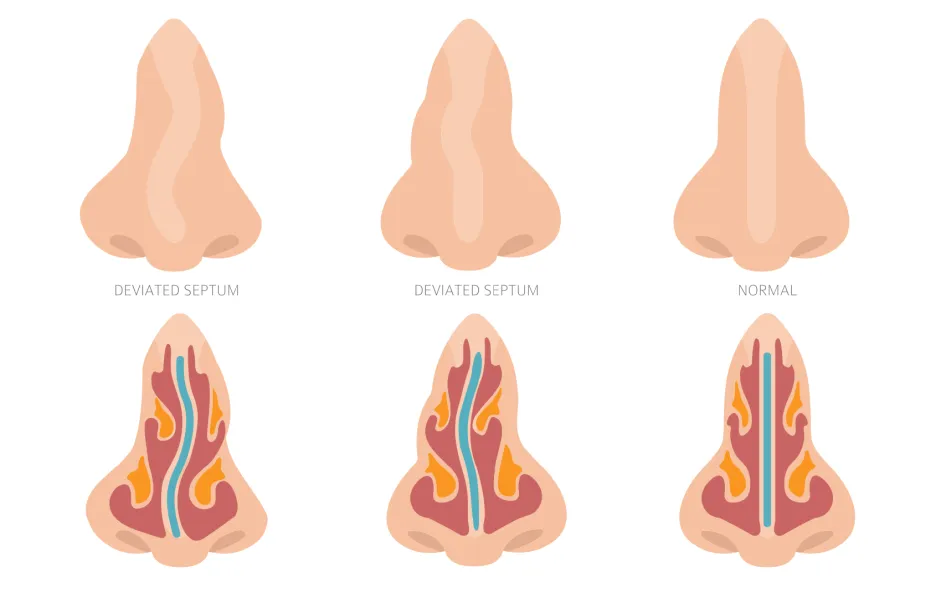
Think of your nasal cavity as a room. The septum is the wall in the middle. This wall is made of cartilage and bone, covered by a layer of mucosa. Very few people have a perfectly straight septum – most have a slight curve.
So when is it considered a "disorder"? When the septum bends too far to one side (or both sides), or develops a localized ridge, causing nasal/sinus dysfunction and symptoms like congestion, nosebleeds, or headaches – that's when you need to pay attention.
If the nose is crooked,
is surgery always necessary?
Many people get nervous at the word "deviation." But the truth is, if it causes no symptoms, it generally requires no treatment.
If you also have recurrent rhinitis, doctors usually recommend trying conservative treatment first – like nasal sprays or regular medication. Often, symptoms can be managed.
So when is surgery considered?
Simply put, three conditions:
Conservative treatment tried and failed;
Symptoms like congestion, headaches, nosebleeds, snoring are getting worse;
These problems are confirmed to be caused by the deviated septum.
If all three apply, surgery becomes an unavoidable option. And what really makes people hesitate is often the surgery itself.
A new septoplasty technique:
No wall demolition, no nasal packing
Patients fear surgery – not the procedure itself – but the days after: unable to open your mouth, unable to sleep, and the excruciating pain when the packing is pulled out. The fear that your nose bridge will collapse.
Is there a surgical method that solves all these worries at once?
Yes!
The "3 Preserve, 2 Correct, 1 Suture" Packing-Free Correction was created exactly for this.
Developed by the expert team at Shuren Eye & ENT Hospital, led by Dr. Zuo Kejun, this improved technique has been refined through long-term clinical practice. It helps patients truly say goodbye to the "torture of packing."
The core logic is very simple: Preserve rather than demolish; suture rather than pack.
3 Preserve
Three things that must not be damaged
Preserve the mucosa – The mucosa is like wallpaper. If one side is torn during surgery, it is immediately sutured and repaired on the spot, preventing postoperative bleeding and infection, and avoiding septal perforation.
Preserve the bone – In the deviated area, precisely measure the curved bone and remove the absolute minimum ("less is more"). Realign adjacent bone fragments so they fit tightly, protecting the septal scaffold.
Preserve the shape – Because the mucosa and bone are preserved, the shape of the nasal bridge and tip naturally does not collapse. The most feared complication of traditional surgery – a sunken bridge – is maximally avoided here.
2 Correct
Function and form – both corrected simultaneously
Comprehensive correction of septal deviation – Deviations come in many forms: C-shaped, S‑shaped, localized ridges or spurs. Traditional "one-cut-fits-all" surgery often leads to poor results or recurrence. The "2 Correct" approach precisely analyzes the type of deviation and tailors the correction – not missing the anterior or high areas that are prone to being left untreated – achieving truly comprehensive correction.
Partial correction of external nasal deformity – If the patient also has a crooked or narrow anterior nostril, or a mildly crooked nasal bridge, these can be corrected in the same surgery. (Of course, the exact plan should be determined by a doctor after an in-person consultation, prioritizing resolution of the disease.)
1 Suture
The key to completely eliminating packing
This is the step that makes the biggest difference in patient experience.
By using a rational combination of intranasal suturing techniques – including septal suturing and inferior turbinate suturing – postoperative nasal packing is eliminated. This prevents hematoma, enhances septal shaping, and promotes recovery.
No packing means:
You can breathe through your nose normally after surgery, not just through your mouth;
You can eat and sleep normally;
And you never have to go through the painful process of "packing removal."
If you haven't had a full night's sleep in a long time because of a deviated septum, or if you've been putting off surgery out of fear –
Why not come to Shuren first for a professional evaluation and see if you're a candidate for this new technique?
Shuren
As a medical institution specializing in ENT, Shuren is constantly refining and innovating surgical methods – striving not only to solve patients' problems but also to provide a more comfortable postoperative recovery experience. Making every treatment not only effective but also compassionate.
You don't have to endure nasal congestion and headaches anymore.
And you don't have to fear surgery.
Medicine is advancing. Don't let past experiences determine today's choices.
The sleepless nights from congestion, the hard-pressed days from headaches – they can all become the past.
A correct treatment choice can unload a burden you've carried for years.
May every breath you take from now on be easy and free.