"Doctor, I've had rhinitis for years. Every winter, my nasal congestion gets worse, and nasal sprays don't help anymore." In the ENT clinic, such complaints are heard almost daily.
But after carefully examining Mr. Zhang's nasal cavity with an endoscope, the doctor gave an unexpected reply:
"This isn't simply rhinitis; it's primarily a deviated nasal septum."
Mr. Zhang was stunned—it was the first time he had heard this term, and he couldn't understand how the "rhinitis" he had been treating for years had suddenly become "my nose is crooked."
Your Nose
May Never Have Been Truly "Straight"
01
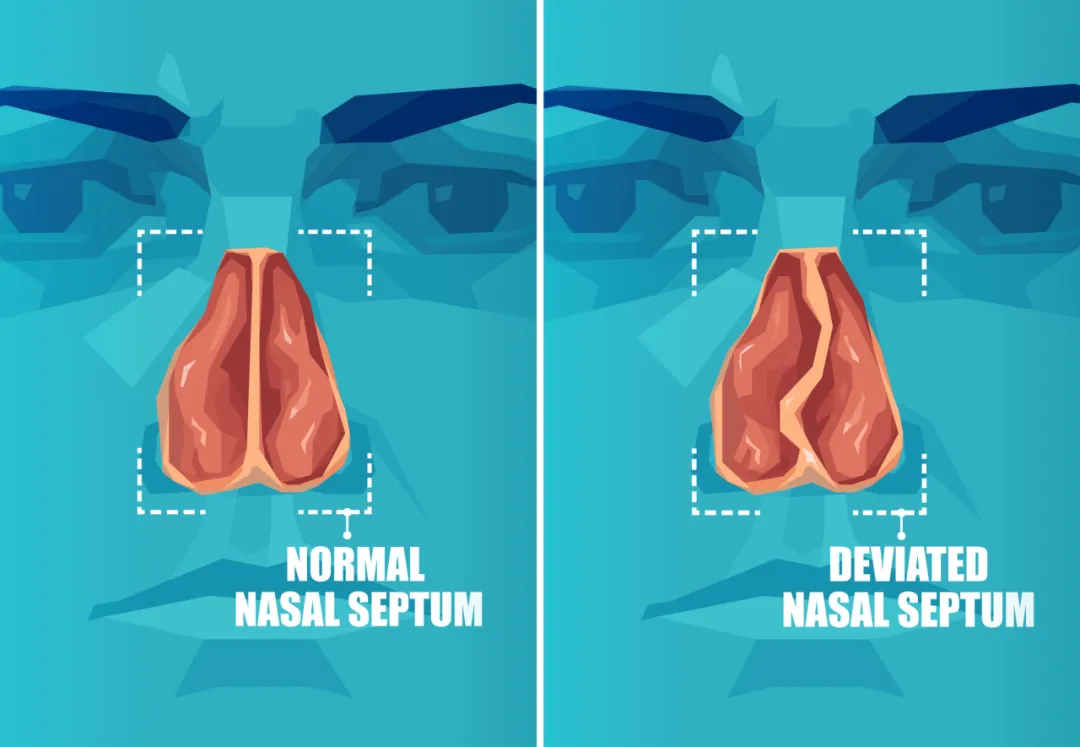
Imagine a "partition wall" in the middle of our nasal cavity, medically called the nasal septum. Composed of cartilage and thin bone, it divides the nasal cavity into left and right passages. Ideally, this "wall" should be straight and centered.
But in fact, studies show that about 70%-80% of adults have a deviated nasal septum to varying degrees. Most deviations are physiological, do not affect normal breathing, do not cause disease, and do not require special treatment.
However, when the deviation is severe, problems arise: the passage on the deviated side narrows, causing nasal congestion. To compensate for the airflow imbalance, the turbinate tissue on the other side may also become hypertrophic. The result is often that not only is the narrow side blocked, but the originally spacious side also becomes obstructed due to compensatory turbinate hypertrophy, creating a dilemma of bilateral obstruction.
Even worse, if there is a sharp bony protrusion (called a "spur" or "ridge") at the deviated site, the problem becomes more complex and may trigger a series of symptoms such as headaches and recurrent nosebleeds. At this point, the underlying "structural issue" becomes even more significant.
Why Is It Often
Mistaken for "Rhinitis"?
02
You may have been puzzled: Why do the symptoms keep recurring and the treatment effects remain limited despite ongoing treatment for rhinitis? This is because a deviated nasal septum often "disguises" itself as rhinitis. Its manifestations are very similar:
Symptoms are too similar: Nasal congestion, runny nose, decreased sense of smell... These symptoms are almost identical to those of rhinitis;
Often accompanied by inflammation: The deviation leads to poor nasal ventilation and secretion retention, which can easily trigger or worsen rhinitis and sinusitis, intertwining the structural problem with mucosal inflammation;
Medications provide only temporary relief: Nasal sprays can reduce mucosal swelling and may temporarily improve congestion caused by the deviation, but this "illusion" often leads people to mistakenly believe they have found the cause.
This discomfort might be tolerable at other times, but in winter, the cold, dry air makes the nasal cavity drier and more fragile, further exacerbating the already restricted ventilation function.
Three "Structural Alarms":
Key Signals Differentiating from Rhinitis
03
If your nose exhibits these signals, be wary that it might not be simple rhinitis:
×
Signal 1: One side is always more congested
Nasal congestion from common rhinitis often alternates between the left and right sides, whereas congestion caused by a deviation is usually more severe on one fixed side, or noticeably asymmetric on both sides, and persists year-round.
×
Signal 2: Recurrent nosebleeds from the same spot
If nosebleeds always come from the same location, especially in dry seasons, this may signal mucosal damage at the site of the deviation's protrusion.
×
Signal 3: Headaches in specific areas
When the deviation presses on nerves, it may cause deep-seated headaches, typically around the orbits, forehead, or temples, feeling like a pulling pain.
Diagnosis and Treatment:
One Examination to Clarify the Direction
04
If you have been suffering from long-term nasal issues, especially if the above characteristics apply, it is recommended to undergo a professional examination at an ENT department:
Nasal endoscopy: The doctor will use a thin but high-definition scope to examine the inside of your nasal cavity;
CT scan: Provides a more comprehensive understanding of the nasal structure, offering detailed references for treatment.
Regarding treatment, always follow an important principle: look at the scans, not just the symptoms.
If symptoms are mild, daily care such as nasal irrigation and using humidifiers can help. If symptoms are significant—nasal congestion, headaches, etc.—and affect daily life and sleep, surgical correction of the structure should be considered.
Don't worry! Modern deviated nasal septum correction surgery is quite mature, including submucosal resection of the nasal septum, septoplasty, and septorhinoplasty, among others. These procedures correct the deviated structure through internal nasal operations while appropriately reducing hypertrophic turbinates. The surgery leaves no external scars, recovery is relatively quick, and it can fundamentally resolve breathing problems caused by structural abnormalities.
Recurrent nasal discomfort in winter,
don't just dismiss it as "chronic rhinitis"!
Recognize the key signals,
and you might find the answer to years of distress.
A professional nasal examination
can open a new door for your breathing.
This winter, let's understand our noses better
and breathe a little more freely.