After turbinate ablation, you breathed freely for a few months, only for the nasal congestion to come back. Have you also been trapped in the cycle of "treatment — relief — relapse"? The issue might not lie with the surgery itself, but with your nasal breathing having attained only a "false balance."
01 What is "True Balance" in Breathing?
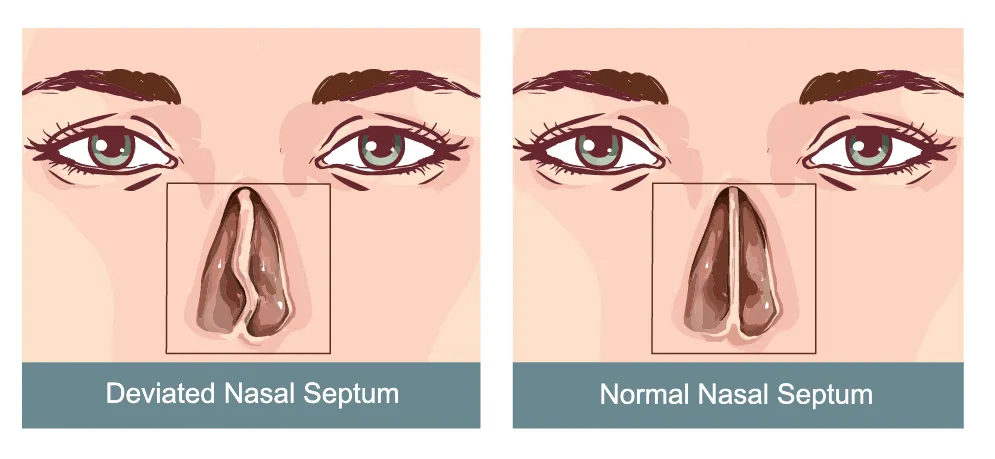
True respiratory balance stems from the symmetry of nasal cavity structures. Just like a bridge requires both piers to be stable and aligned for smooth traffic flow, so does our nasal cavity. The straight, centered nasal septum acts as the "load-bearing wall," evenly dividing the left and right passages, with both sets of turbinates working in coordination to ensure smooth, deep airflow.
"False balance," on the other hand, is when only the turbinate swelling—the "surface congestion"—is addressed, while the deviated nasal septum—the "tilted bridge"—is overlooked. Even if the airway is temporarily widened, with an unaligned foundation, the bottleneck persists, and congestion is bound to recur.
02 A Typical Story: Mr. Lin Misled by "False Balance"
A year ago, Mr. Lin underwent turbinate ablation for stubborn nasal congestion. Post-surgery, he indeed enjoyed a period of free breathing. However, the good times didn't last, and the familiar feeling of blockage returned.
Imaging during a check-up revealed that his turbinates had not enlarged again. The real culprit was hidden in the center of the images—his nasal septum showed a significant deviation to the right.
It turned out that the relief he initially gained was merely a temporary improvement achieved by reducing the turbinates (clearing the "roadblock"). Meanwhile, the persistently right-deviated nasal septum ("tilted bridge") continued to compress the right airway. When the remaining mucosa became slightly swollen, or the compensating turbinate became overburdened, nasal congestion immediately reappeared. He had only solved the "false balance"; the true structural imbalance had been there all along.
03 Deviated Nasal Septum: The "Skeletal Misalignment" That Breaks True Balance
The nasal septum, the central partition of the nasal cavity, is composed of the perpendicular plate of the ethmoid bone, the vomer, and the septal cartilage.
In fact, a completely straight and centered nasal septum is rare; most people have slight physiological deviation. However, when it curves excessively or forms sharp spurs, it constitutes a deviated nasal septum.
It brings not just unilateral physical narrowing, but triggers a series of chain reactions:
"Overwork Hypertrophy" of the Contralateral Turbinate: The turbinate on the wider side undergoes compensatory hypertrophy to handle more of the breathing workload.
Airflow Turbulence and Inflammatory Cycle: Abnormal airflow repeatedly irritates the mucosa, inducing persistent edema, leading to a vicious cycle of swelling and blockage.
Symptom Complexification: Leads to stubborn nasal congestion, recurrent nosebleeds, headaches, and can even affect the sense of smell and sleep.
It is particularly noteworthy that the location of the septal deviation is often more critical than its degree. This is especially true for the nasal valve area—it is the narrowest part of the nasal airway and the most critical region for generating nasal resistance.
Therefore, even a slight deviation or spur in this area can severely obstruct airflow like a "bottleneck in a waterway," causing a noticeable sensation of nasal congestion. Inexperienced doctors sometimes overlook subtle structural abnormalities in this region, yet it is precisely the slight imbalance in this location that often becomes the hidden culprit behind breathing difficulties.
On a misaligned skeletal framework, any localized adjustment to soft tissue is unlikely to have lasting effects.
04 Rebuilding "True Balance": Correcting Structure for Long-lasting Relief
Restoring lasting, comfortable breathing hinges on fundamentally rebuilding the structural balance of the nasal cavity. This requires first correcting the "load-bearing wall"—the nasal septum—to restore it to the center, and then meticulously adjusting the turbinates on both sides accordingly.
This is like road repair: first, the tilted main road must be straightened and widened; then, greenery and facilities along the route can be reasonably arranged to achieve long-term, smooth, and efficient traffic flow.
At Renshu Eye, Ear, Nose & Throat Hospital, from personalized pre-operative assessment to anesthesia choice, from surgical procedure to post-operative recovery, every step centers on patient comfort and long-term outcomes.
We employ bone-preserving, packing-free techniques that allow for precise correction of the deviation while significantly reducing post-operative swelling and discomfort. The use of new materials like packing sponges with air vents also greatly alleviates the nasal blockage sensation caused by traditional packing.
Therefore, most patients do not need to endure a lengthy recovery period. They can typically be discharged within one or two days after surgery, quickly returning to clear breathing and daily life.
True respiratory freedom originates from deep-seated symmetry.
If you are also trapped in the cycle of recurring nasal congestion, perhaps it's time to examine:
Have you only settled for temporary "false balance,"
while overlooking the deeper "structural truth"?
Breathing freely is never just about "roominess."
It's about symmetry, about balance,
about that "centered path" where airflow moves smoothly within the nasal cavity.